Monday, September 23, 2019

Lower Glanmire Road/Water Street - December 9 1920


It was 4:30 on the evening of Tuesday December 9th 1920 when John Fleming and his two brothers and a friend were making their way back from Horgans Quay. They had been down at the quay where a British vessel was docked. 

The Fleming brother's friend was an ex British soldier who wanted to leave Cork and they were there organising his passage home with the British vessel. They were told to come back in an hour and the men decided to head up Water Street to a pub where they would kill the hour.


John Fleming was a 36 year old married man from Cattle Market Street on the north side of the city. He was an ex member of the Royal Navy in which he had served 22 years. He served during World War I and saw action at the Battle of Jutland. 


                                                                      John Fleming


As Fleming and his brothers, along with their friend, reached the top of Water Street at it's junction with the Lower Glanmire Road they heard the sound of lorries approaching at high speed.
 The men made a dash across the road for the public house but just as they did three Crossley Tenders of Auxies sped past and a hail of bullets rained down in their direction. John Fleming shouted out "I am shot!" He stumbled towards the footpath before collapsing near the wall of a house.


The Freeman's Journal December 9 1920


An ambulance brought Fleming to the North Infirmary where an operation to remove the bullets from his abdomen proved unsuccessful and he died shortly after 8pm that night. 


Irish Independent December 9 1920


The British authorities denied the bullets which killed Fleming came from their guns. The Fleming brothers and their friend stated the opposite. 
The auxies had earlier that day been rampaging across Cork city, or as they called it "performing searches." They had ransacked homes and looted shops. Troops racing around the city in lorries shooting wildly had become a common feature of life on the streets of Cork during those tense times and John Fleming was one such victim of their unruly actions.


The junction of Water Street and Lower Glanmire Road which is today forming part of the Horgans Quay redevelopment site.

Monday, September 9, 2019

Grand Parade - December 8 1920


Harriet King Meara was standing near Finns Corner when she stepped off the footpath to cross over to the Grand Parade. Unfortunately for the elderly lady, four lorries of Auxiliaries were hurtling up Great Georges Street (today's Washington Street) and as they rounded the corner onto the Grand Parade they proceeded to knock her down.


Harriet Meara was taken to the Mercy Hospital where she was pronounced dead on arrival. The unfortunate lady had a severe wound to the back of her head. She was identified in the hospital by Dean Babbington of St Fin Barre's Cathedral as one of his congregation. 


Harriet Meara lived with her sister at Wellington Avenue off College Road and was a familiar fixture at St Fin Barre's where she would help out and sing with the choir. 


                    Singers Corner & Finns Corner on the Grand Parade in the early 20th century


In a military court of inquiry following Harriet's death the driver of the Crossly Tender which knocked down the elderly lady proclaimed it was impossible to avoid her. The court declared Harriet's death an accident.


Singers Corner & Finns Corner, early 20th century


The four military lorries had been speeding into Cork city from Macroom carrying members of the notorious C Company of the Auxilary Division based in Macroom Castle.


Military vehicles knocking down pedestrians had become a common aspect on the streets of Cork during the War of Independence. Harriet King Meara was not the first and neither was she to be the last unfortunate person killed by a speeding crossly tender on the streets of Cork.


1940s Finns Corner

Today's Singers Corner - Finn's Corner.

Thursday, September 5, 2019

Empress Place - Summerhill


Following a bomb attack on the King Street (MacCurtain Street) RIC Barracks in 1920, the authorities abandoned the destroyed building in favour of a bigger fortress not far away up Summerhill. 
Empress Place sat in a prime position on Summerhill North overlooking the city and in the words of Captain Sean Healy of the First Cork Brigade it was "A den of iniquity in our midst."


The aftermath of the IRA attack on the King Street (MacCurtain Street) RIC Barracks.


The big brooding building known as Empress Place was built in 1874 and was named after the Empress of Austria who was a close friend to the family of Viscount Langford who owned land in Cork. 


Empress Place was home to the dreaded K Company of the Auxiliary Division. Approximately 50 Auxies from this brutal company were commonly referred to in Cork as "The Murder Gang" and very few who fell off into their hands survived. 


When the authorities moved into Empress Place the local Republicans plastered "welcoming" posters around Summerhill which read:
"Whereas the spies and traitors known as the RIC are holding this country for the enemy and whereas said spies and bloodhounds are conspiring with the enemy to bomb and bayonet and otherwise outrage a peaceful law abiding and liberty loving people. 
Whereas we do hereby proclaim and suppress said spies and traitors and do hereby solemnly warn prospective recruits that they join the RIC at their own peril."


Members of K Company "Murder Gang" at the Railway Station on the Lower Road.


Sean Healy, Captain in the Cork No.1 Brigade IRA recalled Empress Place - " If the walls of this new hell could only speak they would reveal a number of inhumane tortures perpetrated under the fair name of law and order......."


Healy was one of the few who was held in Empress Place and survived to tell the tale:

Bureau of Military History Witness Statement of Captain Sean Healy Cork IRA


During the burning of Cork in December 1920 Auxies and Tans were seen taking loot from Hilsers, Murphys, Mangans and several pubs to Empress Place. Today the building is home to EIL International Learning. 


                             A tram on Summerhill , not far from Empress Place.


Wednesday, August 28, 2019

Emmet Place/Lavitts Quay -June 28 1921


William Horgan was a 29 year old from Dillons Cross who worked as a fireman with the Great Southern and Western Railway. Just shortly after 2am on June 28th 1921, soldiers from the South Staffordshire Regiment arrived at the Horgan home and lifted William from his bed.  It was the last time his parents saw him alive. 

William was put into a lorry along with another local man by the name of Lenihan who was also taken from his bed in handcuffs. The lorry sped through the streets of Cork but then came to a stop outside the Opera House, at Emmet Place/Lavitts Quay.


                                                 Lavitts Quay and the old Opera House


According to the British military the lorry broke down and both Horgan and Lenihan grappled with soldiers. Lenihan managed to flee the scene while William Horgan was shot dead. In the inquest which followed, his father claimed that he was not involved with the Republican movement and that it was not in his nature to grapple with armed British soldiers. 


                                    The Opera House Emmet Place & Lavitts Quay


The officer in charge on the night of William Horgans murder was Lieutenant Adelin Eugene Paul Firmin Marie Ghislaine van Outryve d'Ydewalle. This Beliguim born Sandhurst commissioned British officer was well known on the streets of Cork as a dubious character who had no qualms in shooting prisoners "trying to escape." 

The South Staffordshire Regiment 2nd Battalion moved to Victoria Barracks ( Collins Barracks) on the northside of Cork city in 1919 and had a  reputation for brutality.


Emmet Place, Crawford Art Gallery and Opera House.


On the 27th of June the IRA ambushed three Staffordshires walking back to barracks after a night in a local pub. As they walked by Mayfield Road a volley of shots were fired in their direction wounding two and killing one - Private Frederick Crowther. It was this ambush which saw Lieutenant d'Ydewalle set off looking for revenge and the route took him to the home of the innocent Horgan family in Dillons Cross.


  Report from Freeman's Journal on the Mayfield Road ambush.


Despite the father of William Horgan claiming at his son's inquest that he was an innocent civilian, the military verdict decided differently and believed the statement of Lieutenant d'Ydewalle and his soldiers in the South Staffordshire Regiment.

The Staffordshires would remain in Cork until 1923 when they returned to England and from there they took their bad reputation to Palestine. Lieutenant d'Ydewalle survived the War of Independence despite attempts by the First Cork Brigade to rub him out.


William Horgan

Friday, August 16, 2019

Emmet Place - November 16 1920


On the afternoon of November 15th 1920 two plain clothes Auxiliaries arrived in a motorcar at the Johnson & Perrott garage on Emmet Place ( formally Nelsons Place.)
 They left their vehicle there for a service and then headed across town to the South Mall where they checked into The Imperial Hotel for the night.


              19th century postcard of Johnson's garage on Nelson (Emmet) Place.


Auxiliary cadets Bertram Agnew and Lionel Mitchell were on 24 hour leave from their barracks in Macroom Castle. They arrived in the city wearing their civvies and they were carrying cameras. They also carried service revolvers. 

Following breakfast in The Imperial Hotel on the morning of November 16th Agnew and Mitchell went to collect their car. When they arrived at Johnson & Perrott they were met by volunteers from the First Cork Brigade who were laying in wait for them. 


        Johnson & Perrott garage on Emmet Place before it was demolished in 2008


The Auxies did not put up much resistance. Agnew and Mitchell, along with their vehicle, were taken to Rusheen on the northern outskirts of the city and handed over to IRA E Company. 

Mitchell was a 23 year old from Somerset who served as a Lieutenant with the Royal Berkshire Regiment in Flanders during WWI where he was awarded the Distinguished Service Medal. In August 1920 he joined the Auxileries and became a section leader. Agnew was a 24 year old from Lancashire and a former Navy Reserve sailor. He had joined the Auxiliary Division just two months before he was captured on Emmet Place.


          Sing Sing Prison at Knockraha cemetery in North Cork.


The IRA had information that the two Auxies were in the city on intelligence work. It did not help their case that they were both based in Macroom Castle which hosted the worst of the worst in enemy uniform. The fates of Agnew and Mitchell were sealed and after some time spent in Sing Sing, the two men were taken to the Rea Bog where they were shot and buried.


                                            Inside Knockraha's Sing Sing Prison


The authorities in Macroom sent search parties to the city on the 20th of November but their search proved fruitless as neither car nor men were ever recovered.


Both Agnew and Mitchell remain buried in the Cork bog to this day. In the mid 1920s the bodies of several enemy soldiers who were shot and buried by the IRA were returned to their families. Agnew and Mitchell were the exception for some unknown reason. 

The man in charge of 'disappearing' people in the Rea Bog was Martin Corry. Known as the Cork IRA's 'chief executioner' it is thought he oversaw the burial of up to 30 bodies in the north Cork bog near his home. Corry later enjoyed a long career as a Fianna Fail councillor and TD.


As for the auxie's motorcar, it was taken to a mechanic in a mountainy area of Muscrai where the chassis was used in the making of the IRA's armoured car called The River Lee which would serve against Free State troops during the Civil War.


        Emmet Place today. TopShop sits where Johnson & Perrott once stood.


Tuesday, August 13, 2019

Lower Glanmire Road - May 11 1920


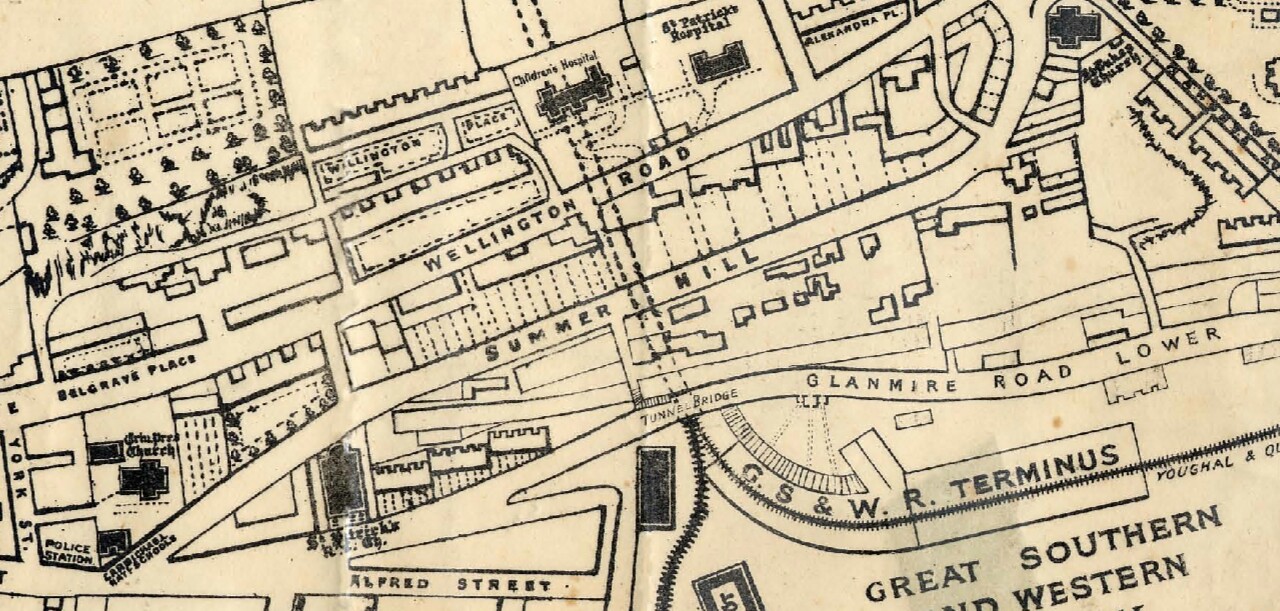
At 10:30pm RIC sergeant Denis Garvey and Constables Daniel Harrington and Patrick Doyle left their barracks on the Lower Glanmire Road to board a tram for Popes Quay. The tram was coming from Tivoli and onboard were gunmen from E Company of the IRA First Cork Brigade.


                      Circled on the left is the RIC Barracks on the Lower Glanmire Road. 


The tram came to its stop on the Lower Glanmire Road and as the Sergeant and constables boarded it  a hail of bullets greeted them. Passengers ran from the tram as the gunmen finished their job before fleeing the scene. 


Tram on the Lower Glanmire Road.


Sergeant Garvey was shot dead with four bullets while Constable Harrington was killed with eight. Constable Doyle somehow managed to run away with three gunshot wounds and survived to tell the tale but, not the identity of the gunmen who had worked with great efficiency.


                                                 Modern day Lower Glanmire Road 


This wasn't just a random killing, it was a well planned attack and the primary aim was Sergeant Garvey. The Active Service Unit of the First Cork Brigade had Sergeant Garvey in their sights since the murder of Lord Mayor Tomas MacCurtain in March 1920. It was strongly suspected Srgt Garvey had a role in it. His movements were closely watched in the weeks leadng up his shooting and it was agreed to  "get Garvey" as he left for the 10:30 tram on a nightly basis from the barracks on the Lower Glanmire Road.


Military Witness Statement of Cpt Sean Healy Cork No.1 Brigade 


Under the leadership of Pa Murray nine volunteers of E Company carried out the shooting.  In the immediate aftermath it was feared Terence MacSwiney, who succeeded MacCurtain as Lord Mayor, would be a target of a revenge attack by the RIC. 


MacCurtain's gun in Cork Public Museum. 


17 volunteers were posted at MacSwiney's house armed to the teeth with rifles and bombs brought in on pony and cart by the Bowles family from Clogheen but, the anticipated revenge attack did not happen.


Witness Statement of Daniel Healy o/c Active Service Unit C Company 1st Batt IRA


Constable Harrington was a 44 year old with 20 years service in the RIC and was from Bantry where he was buried.


Sergeant Denis Garvey 


Sergeant Garvey was a 47 year old Kerry native with 25 years service in the RIC. His funeral procession went through the streets of Cork accompanied by bands and marching soldiers from the Hampshire, Oxfordshire and Buckinghamshire Regiments. He was buried in Aghadoe, Killarney, leaving a widow and eight children.


From the Bureau of Military History - Those Involved in the Lower Road Action