Monday, October 14, 2019

Grand Parade - September 2 1922


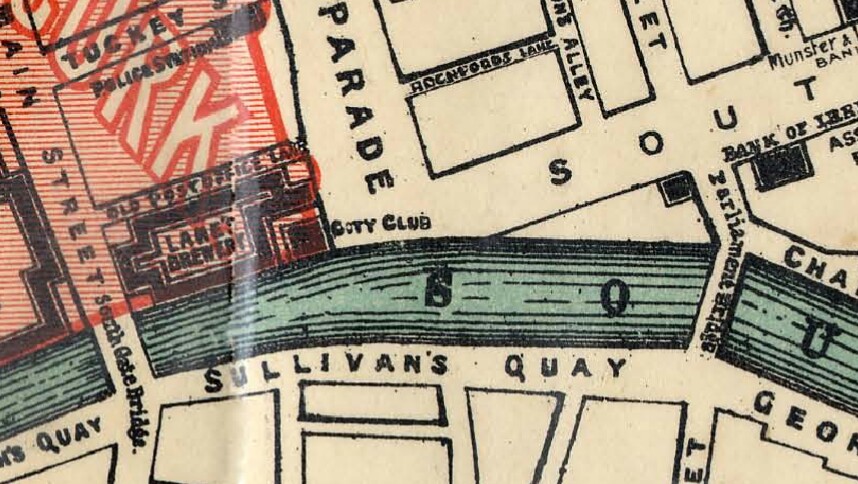
It was on Saturday morning just after 10am as a group of Free State soldiers of the Curragh Reserve were gathered outside the Cork City Club on Grand Parade. The  City Club had been be taken over by Free State forces and it was here where Soldiers received their wages. The group waiting outisde the City Club on that morning were waiting to draw their pay. 


              The Cork City Club at 46 Grand Parade, now home to C.I.T Arts office.


At the same time, an anti-treaty IRA volunteer drove a motorbike with a machine gun mounted on it's side car up Sullivan's Quay and proceeded to fire at the Free Staters at the other side of the river. Two IRA rifle men were positioned in a building at the corner of Sullivan's Quay and Friary Lane while two more were positioned on a low flat roof of the building. After firing on the Free Staters, the driver of the motorbike abandoned his deadly mode of transport at South Gate Bridge and disappeared on foot up Barrack Street while the riflemen in the building on Sullivan's quay also disappeared into the laneways of South Parish. 


Sullivan's Quay on the left where the IRA launched their attack on the Free Staters outside the City Club at the opposite side of the river. Today at that spot, Nano Nagle footbridge connects Sullivan's quay and the Grand parade. 


The surprise attack left 19 wounded Free State solders and two dead on the spot.  Private Michael Francis Behan was a 21 year old from Smithfield, Dublin. He was six weeks in the army when a bullet pierced his head and killed him instantly on the Grand Parade. Behan was a member of the Third Order of St Francis who formed a guard of honour at his funeral in Glasnevin cemetery. Before joining the Free State Army he worked for the Dublin Gas Company. 


                             Free Staters outside the City Club on the Grand Parade.


Private Thomas Conway was an ex British soldier who had served in WW I. He lived wth his brother and his family in a tenement on St Augustine Street in Dublin and was killed instantly during the attack outside the Cork City Club.


Free Staters at the National Monument on the Grand Parade


Private James McCann was a Glaswegian who died from his wounds in the Mercy hospital on the 14th of September, 12 days after the attack on Grand Parade. He was a member of the Govan branch of Na Fianna Eireann in 1917 before joining the 1st Battalion Scottish Brigade IRA. The 21 year old's parents in Glasgow were awarded £180 per annum by the state pensions board following his death.  He was buried in the Free State plot in Glasnevin cemetery


Free Staters outside the Cork City Club. These photos were taken weeks before the attack.


Private James Yates died in the Mercy hospital on the 16th of September. Machine gun fire had obliterated his right leg and he had it amputated but, Yates did not survive the sepsis which followed.  Yates came from Capel Street in Dublin city and was a van driver for the local fruit market before joining the Free State Army. Yates was married with a three year old daughter and his widow Bridget was awarded an allowance of 17shillings 6pence throughout her widowhood. Like McCann, Yates was also buried in the plot which surrounds the grave of Michael Collins in Glasnevin cemetery


Thursday, October 10, 2019

Grand Parade - February & March 1922


The Grand Parade was the stage for two large rallies in early 1922. It was on Sunday afternoon, February 19th 1922 when an Anti-Treaty rally drew a large crowd to two platforms, one erected near the National Monument and the other next to the Berwick Fountain. 


                                     The Grand Parade in the early 20th century.


Special trains were put on to bring people in from the country while companies of IRA Volunteers lined the South Mall, Washington Street and the Grand Parade. THe Working Mans Brass Band, The Volunteer Pipe Band and the McCurtain Memorial Band among many others provided the musical entertainment. 


Dev at the platform near the National Monument. 


The platform at the Berwick Fountain was the setting for the first part of the rally. Lord Mayor Donal O'Callaghan opened the rally with an address in Irish before introducing Eamon De Valera who started his speech with "Up The Republic!" It sent the Cork crowd wild and after the cheering died down Dev unleashed a tirade against the Anglo Irish Treaty.


 Dev on the platform near the Berwick Fountain.


The party then proceeded to the second platform at the far end of the street for another wave of speeches against the treaty. Also speaking that day were Liam Mellows, Cathal Brugha , Sean MacSwiney and Countess Markievicz. The rally ended peacefully with a band playing the Soldiers Song and everyone went on their way. The same could not be said of the Pro Treaty rally in the same place a month later.


                     Michael Collins addressing the pro treaty rally on Grand Parade.


On Sunday March 12th 1922 over 50,000 people crammed into the Grand Parade to hear Michael Collins speak in favour of the treaty he had signed in London months before. He had arrived into the city the night before and was greeted at the train station by large crowds before he and his entourage were escorted through the streets by torch bearers and a brass band to his lodgings in the Turner Hotel at 64 George's Street (today Oliver Plunket Street.)


Then and now - 64 Oliver Plunkett Street


On the morning of the rally, Collins and his entourage attended 10;15 mass at St Francis Church on Liberty Street. After that they travelled to St Finbarrs Cemetery to visit the Republican Plot but, they were met at the gates by armed men.


Collins outside St Francis Church with, from L-R, Diarmuid Fawsitt, Commandant Cooney, Padraig O'Keeffe TD, Fr Sheehan, Rev. Walsh, General Sean MacEoin. 


Collins and co met up to 30 armed ani-treaty IRA volunteers at the gates of St Finbarrs Cemetery and a heated argument erupted. They were preventing Collins and the rest from entering the cemetery to the the Republican plot and it enraged the Big Fella. 


De Valera paid a visit to the Republican Plot just a month previously with Liam Mellows, Cathal Brugha and Maire Mac Swiney.


The standoff lasted for almost half an hour as both factions exchanged words and almost came to blows when finally Patrick Barry, brother of Tadhg Barry, pushed his way past the men at the gate and visited his brothers grave. General Sean McEoin also tried to push his way past but he was pulled back by Collins who then agreed to leave the scene for fear gun fire might erupt. 


The St Finbarrs Republican Plot 1922.


          Collins being presented with flowers by local children on the Grand Parade.


Before taking to the platform for the Pro Treaty rally on that Sunday afternoon, Collins was presented with a bunch of lily flowers by a girl and boy from the tenement buildings near Grattan Street. Barry Egan presided over the rally and Liam de Roiste spoke first.


       The overcrowded platform for the pro treaty rally. It's a wonder it didnt collapse!


After de Roiste finished his speech in Irish he introduced Collins and the large crowd erupted into frenzied cheering which went on for several minutes. The Galway Observer of March 18th 1922 reported "Not since the days of Parnell has the city witnessed a meeting so enthusiastic.....in dimensions the gathering was larger than Mr de Valera's recent gathering....."


                       Collins delivering his pro treaty speech on the Grand Parade.


As Collins finished his speech a ruckus kicked off at the rear of the platform when a number of men began pushing each other and shouting insults.


                             Trouble breaking out at the rear of the platform.


One man drew his pistol while another flung his fists in the face of another. People scattered in all directions as the charged atmosphere grew out of control. When shots were fired in the air the rally came to an abrupt end.


People, including children, running away from the trouble.


The violent end to the Pro Treaty rally showed the deep division which had already been cut into Irish society early in 1922. It was just the begining of more bloodier scenes to play out on the rebel streets of Cork in the coming months.


*Newsreel footage of the pro treaty rally can be seen on YouTube or the Irish Film Institute Player*

https://youtu.be/mPqLISbpzUE


Monday, September 23, 2019

Lower Glanmire Road/Water Street - December 9 1920


It was 4:30 on the evening of Tuesday December 9th 1920 when John Fleming and his two brothers and a friend were making their way back from Horgans Quay. They had been down at the quay where a British vessel was docked. 

The Fleming brother's friend was an ex British soldier who wanted to leave Cork and they were there organising his passage home with the British vessel. They were told to come back in an hour and the men decided to head up Water Street to a pub where they would kill the hour.


John Fleming was a 36 year old married man from Cattle Market Street on the north side of the city. He was an ex member of the Royal Navy in which he had served 22 years. He served during World War I and saw action at the Battle of Jutland. 


                                                                      John Fleming


As Fleming and his brothers, along with their friend, reached the top of Water Street at it's junction with the Lower Glanmire Road they heard the sound of lorries approaching at high speed.
 The men made a dash across the road for the public house but just as they did three Crossley Tenders of Auxies sped past and a hail of bullets rained down in their direction. John Fleming shouted out "I am shot!" He stumbled towards the footpath before collapsing near the wall of a house.


The Freeman's Journal December 9 1920


An ambulance brought Fleming to the North Infirmary where an operation to remove the bullets from his abdomen proved unsuccessful and he died shortly after 8pm that night


Irish Independent December 9 1920


The British authorities denied the bullets which killed Fleming came from their guns. The Fleming brothers and their friend stated the opposite. 
The auxies had earlier that day been rampaging across Cork city, or as they called it "performing searches." They had ransacked homes and looted shops. Troops racing around the city in lorries shooting wildly had become a common feature of life on the streets of Cork during those tense times and John Fleming was one such victim of their unruly actions.


The junction of Water Street and Lower Glanmire Road which is today forming part of the Horgans Quay redevelopment site.

Monday, September 9, 2019

Grand Parade - December 8 1920


Harriet King Meara was standing near Finns Corner when she stepped off the footpath to cross over to the Grand Parade. Unfortunately for the elderly lady, four lorries of Auxiliaries were hurtling up Great Georges Street (today's Washington Street) and as they rounded the corner onto the Grand Parade they proceeded to knock her down.


Harriet Meara was taken to the Mercy Hospital where she was pronounced dead on arrival. The unfortunate lady had a severe wound to the back of her head. She was identified in the hospital by Dean Babbington of St Fin Barre's Cathedral as one of his congregation. 


Harriet Meara lived with her sister at Wellington Avenue off College Road and was a familiar fixture at St Fin Barre's where she would help out and sing with the choir. 


                    Singers Corner & Finns Corner on the Grand Parade in the early 20th century


In a military court of inquiry following Harriet's death the driver of the Crossly Tender which knocked down the elderly lady proclaimed it was impossible to avoid her. The court declared Harriet's death an accident.


Singers Corner & Finns Corner, early 20th century


The four military lorries had been speeding into Cork city from Macroom carrying members of the notorious C Company of the Auxilary Division based in Macroom Castle.


Military vehicles knocking down pedestrians had become a common aspect on the streets of Cork during the War of Independence. Harriet King Meara was not the first and neither was she to be the last unfortunate person killed by a speeding crossly tender on the streets of Cork.


1940s Finns Corner

Today's Singers Corner - Finn's Corner.

Thursday, September 5, 2019

Empress Place - Summerhill


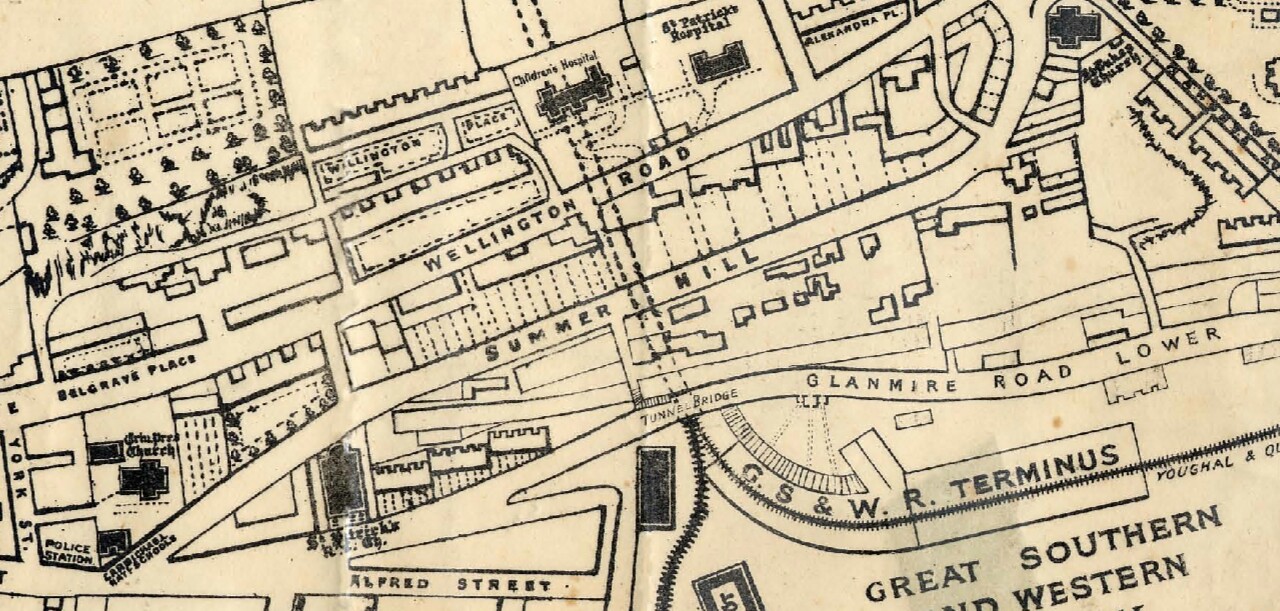
Following a bomb attack on the King Street (MacCurtain Street) RIC Barracks in 1920, the authorities abandoned the destroyed building in favour of a bigger fortress not far away up Summerhill. 
Empress Place sat in a prime position on Summerhill North overlooking the city and in the words of Captain Sean Healy of the First Cork Brigade it was "A den of iniquity in our midst."


The aftermath of the IRA attack on the King Street (MacCurtain Street) RIC Barracks.


The big brooding building known as Empress Place was built in 1874 and was named after the Empress of Austria who was a close friend to the family of Viscount Langford who owned land in Cork. 


Empress Place was home to the dreaded K Company of the Auxiliary Division. Approximately 50 Auxies from this brutal company were commonly referred to in Cork as "The Murder Gang" and very few who fell off into their hands survived. 


When the authorities moved into Empress Place the local Republicans plastered "welcoming" posters around Summerhill which read:
"Whereas the spies and traitors known as the RIC are holding this country for the enemy and whereas said spies and bloodhounds are conspiring with the enemy to bomb and bayonet and otherwise outrage a peaceful law abiding and liberty loving people. 
Whereas we do hereby proclaim and suppress said spies and traitors and do hereby solemnly warn prospective recruits that they join the RIC at their own peril."


Members of K Company "Murder Gang" at the Railway Station on the Lower Road.


Sean Healy, Captain in the Cork No.1 Brigade IRA recalled Empress Place - " If the walls of this new hell could only speak they would reveal a number of inhumane tortures perpetrated under the fair name of law and order......."


Healy was one of the few who was held in Empress Place and survived to tell the tale:

Bureau of Military History Witness Statement of Captain Sean Healy Cork IRA


During the burning of Cork in December 1920 Auxies and Tans were seen taking loot from Hilsers, Murphys, Mangans and several pubs to Empress Place. Today the building is home to EIL International Learning. 


                             A tram on Summerhill , not far from Empress Place.