Wednesday, November 20, 2019

Great William O'Brien Street - October 16 1922


It was 10 o'clock at night when John Patrick Walsh and his wife were making their way back home from the pictures in Blackpool. The pawnbroker's assistant and his wife were heading down Great William O'Brien Street in the direction of their home on Gerald Griffin Street when masked men emerged from a laneway and fired their guns at Mr Walsh. 


The scene of the shooting on Great William O'Brien Street, once known as Great Britain Street.


A number of bullets hit Walsh and he died from his wounds while those who fired the fatal shots disappeared back into the laneways of Blackpool. 
Following his death a sweep of the northside was made by Free State troops and ten arrests were made but, no one was charged. 
Apart from working in a pawnshop, John Patrick Walsh also worked as a driver for Free State troops and this may be the reason for his killing on a dark October night in 1922.


John Patrick Walsh of Gerald Griffin Street.

Tuesday, November 19, 2019

Cove Street - April 17 1921


At 9:45pm Kathleen Murphy was walking with 28 year old Constable John Cyril MacDonald along Cove Street. MacDonald had been in Ireland for four months and was stationed at Union Quay Barracks. He was from Fulham, London, and was a target of the Cork No.1 Brigade. 


                       On the left, where the car is, are the gates to St Nicholas Church.


As MacDonald and his female companion walked by the gates of the now deconsecrated St Nicholas Church two men who were standing by the church gates tackled MacDonald. One of them pinned the hands of the plain clothes constable behind his back while the other one reached for his pistol. MacDonald tried to knock the gun from his attackers hand but it went off and a bullet pierced through MacDonald's face.


                                              The gates of St Nicholas Church.


As MacDonald fell to the ground the two men, who turned out to be members of the Cork No.1 Brigade Active Service Unit, fired more bullets into the Constable, hitting his head and neck. As they ran off in the direction of Sullivans Quay Kathleen Murphy dragged MacDonald into a nearby house before rushing off to the nearby Sullivan's Quay Fire Station for help. 


The scene of the shooting.


When Kathleen Murphy arrived back on Cove Street with firemen they were stunned to see the shot constable stumbling out of the house with his face shot and bloodied. He was intent on making his way back to Union Quay Barracks to report the incident. He was instead taken by ambulance to the Military Hospital where he succumbed to his injuries five days later. 

Monday, November 18, 2019

9 Langford Row - May 15 1921


Just shortly after 2am on the Sunday morning of May 15 1921 the landlady of No. 9 Langford Row, Miss Crowley, was woken by loud knocking on the front door. She hesitated a while before opening the door, these were tense times to be living in. She opened the door slightly and asked who was there but she never got an answer. 


    Langford Row today. This stretch of Cork City, near the South Infirmary Hospital, is named after the Langford Family who were granted land in 1666 by King Charles II. 


Four masked men pushed in the door and roughly brushed past the terrified Miss Crowley. They ran upstairs to a room occupied by Patrick Sheehan and his wife Catherine. The door was locked and as the men started kicking it Mr Sheehan called out from the other side of the door - "Who's there?" 


Patrick Sheehan and his wife Catherine.


One of the masked men asked "are you Sheehan?" To which he replied he was. Then a hail of bullets ripped through the door and into the unfortunate Mr Sheehan. 
The men left quickly as Patrick Sheehan succumbed to a number of bullets which hit his chest and neck. 

 Mr Sheehan was a newly wedded cattle dealer from Newcestown who had no affiliation to either side of the conflict. The IRA denied responsibility and the general theory was that the RIC carried out the killing as a reprisal for the shooting of constables in the area on that same weekend. 

Patrick Sheehan was brought back to his native  Newcestown where he was buried in Templemartin cemetery, leaving behind his widow Catherine. They were married just two weeks before his death on Langford row. 

Wednesday, November 13, 2019

Kyrls Quay - November 8 1920


Just shortly after 10 pm on a bitter cold November night William John Mulcahy was making his way home from work. 
As he walked along Kyrls Quay a group of Auxilaries shot at him. He fell with a bullet that entered his right shoulder and into his stomach.


                                                                Kyrls Quay today.


Mulcahy was a 39 year old Blacksmith from Evergreen Street on the southside of Cork city. 
On the night he was shot by the auxillaries he was on his way home from his workplace at McBrides Agricultural Engineers on Merchants Quay. 


                                                                   Evergreen Street


Mulcahy died in the back of a military lorry as the auxilaries were bringing him to the military hospital on the northside of the city. 
The authorities stated that he failed to stop when asked to do so and he ran. This was deemed a decent excuse by the authorities to shoot an unarmed civilian, it was an excuse used with many other instances of civilians killed by the British forces on the streets of Cork during 1920.


                                                    Mr Mulcahy's place of employment.

Monday, November 11, 2019

Kyle Street - June 26 1921


Shortly after 8pm on a warm June night, Captain Sean Twomey, B Company 1st Battalion Cork No.1 Brigade IRA, was being transferred from the Bridewell on Cornmarket Street to a military lorry, his destination Victoria Barracks (today's Collins Barracks.) The 23 year old IRA captain took a chance as he was being led from the door of the Bridewell to the lorry and he made a dash for freedom. 


Looking at Kyle St from Cornmarket St (Coal Quay) 1930s


Twomey had been arrested on the Grand Parade a few nights previously and when he made his escape he ran, still handcuffed, up Kyle Street in the direction of North Main Street where he lived.


Kyle Street was a busy thoroughfare, even at 8 o'clock at night, people were coming and going. When Twomey ran towards Kyle Street a hail of bullets followed him. 


                            Kyle Street, in the 1960s and now.


Twomey was hit and stumbled into the first open door he saw - Anne Bradleys pub. With a busy street and a hail of bullets there was of course a civilian casualty - Mary Parnell, a war widow in her early 30s with two children. She was standing in the doorway of Bradleys pub when she was hit by a number of bullets.


 Today the site of Anne Bradley's pub where Mrs Parnell was shot to death in the doorway.


Twomey was recaptured as he lay wounded behind the bar in Bradleys pub. He was taken to the military hospital where he recovered just in time to be released for the truce. 


Mary Parnell lived at 11 Kyrls Quay and was known as a supporter of the crown. Her husband Victor was a corporal in the Kings Own Yorkshire Light Infantry Regiment. He fell in action in France in 1914. 


The inquest into her death found that 12 shots had been fired on that summers night on Kyle Street and Mrs Parnell stood in by the doorway of Bradley's pub when she heard the commotion. Unfortunately for her, she stood in the direct line of fire. A soldier testified: "most of her face and the top of her head were shot away."


Monday, November 4, 2019

Imperial Hotel, South Mall - January 5 1921


Just five days into the new year of 1921 an incident occurred in the Imperial Hotel which resulted in the death of a man in strange circumstances.

 Finbarr D'Arcy was a 28 year old from Riverstown, he was an Alexian lay brother. His mother was the postmistress of Glanmire Post Office and by all accounts he was on sick leave from Twyford Abbey in London where he was serving in the nursing home there.

 In 1918 he almost fell victim to the dreaded Spanish Flu but  survived, albeit with his health somewhat damaged. However, on the night of January 5th 1921 D'Arcy had good enough health to be knocking back booze in the bar of the Imperial hotel. 


          Twyford Abbey where D'Arcy was an Alexian lay brother. It closed in 1988. 


Apparently D'Arcy was a regular visitor to the Imperial Hotel anytime he was home in Cork. He signed the visitors book as Rev. Father D'Arcy and at 10:30pm on the night in question, D'Arcy dressed in his clerical garb was intoxicated in the hotel bar and making a bit of a scene.


 The hotel was also a regular haunt for black and tans and  a group of them were in the bar that night and were annoyed by D'Arcy's drunken antics - which is rather ironic when you consider their own drunken antics in Cork!  They told him to leave and D'Arcy obliged but not before snatching one of their hats and an umbrella.


                                     The Imperial Hotel in the early 20th century.


Days before, when D'Arcy was booking into the hotel he specifically asked to stay in room 5.  The GPO could be accessed through this room and at the same time D'Arcy checked in, there was a robbery in the GPO which saw the theft of £8,000.


The GPO in the early 20th century


The tans followed D'Arcy to his room where they ruffed him up and strip searched him. They took their eyes off him briefly and he suddenly dashed for the window and escaped. He scrambled down a drain pipe and managed to get into the servants quarters where he hid under a bed. It did not take long for the tans to find him and they hauled him off. They handed D'Arcy over to the curfew patrol which were the Hampshire Regiment and they had a reputation for shooting prisoners.


Newspaper reports on the Imperial Hotel incident.


D'Arcy was put into a lorry in handcuffs and the Hampshire Regiment took him off in the direction of Victoria Barracks (Collins Barracks) but, he never got there alive.

 The officer in charge Lieutenant AR Koe ordered the vehicle to halt just before they arrived at the Barracks gate. D'Arcy was thrown from the lorry and a shot rang out. The official statement from the British authorties stated he was shot "trying to escape". This was the usual guff with curfew patrols in Cork, many people had been shot in this way. 

The death of D'Arcy left many unanswered questions. Following his funeral at Saint Peter's and Paul's and his burial in St Finbarr's cemetery, rumors about this " Reverend Father" D'Arcy flooded the streets of Cork. 


                                 Witness statement from Barrister Eoin O'Mahoney


 The most popular and possibly truthful story doing the rounds of Cork was this one: D'Arcy and two other men were involved in the theft of £8,000 from the GPO by way of Room no.5 in the Imperial Hotel. They then unwittingly gave the money to a women of illrepute to hold for them but, she made off with it and the three robbers were left fuming, frustrated and angry. D'Arcy took out his frustration through the medium of booze and this ultimately led to his downfall.

 His two accomplices were supposedly an ex British soldier by the name of  Kavanagh and a young student and son of a well known Cork builder, Walter Callanan. A few years later young Callanan would meet his end when he left a dance at the Arcadia Ballroom on the Lower Glanmire Road and was later found dead in the nearby railway tunnel, killed by a train. 

Lieutenant Koe, the officer in charge the night D'Arcy was "Shot while trying to escape"  would be in charge a month later at Clonmult when his troops surrounded an IRA safehouse and massacred most of it's occupants - "Shot trying to escape".  


Tuesday, October 29, 2019

Imperial Hotel, South Mall - October 8 1922


During the Civil War Free State forces took over the Imperial Hotel as their Headquarters. It was from here that Michael Collins set off to meet his death in Beal na mBlath on the morning of August 22nd 1922. Months later a wedding and a shooting took place in the historic hotel.


Michael Collins leaving the hotel (from it's side entrance, near the GPO) during his stay there in August '22. 


                                     The Imperial Hotel in the early 20th century.


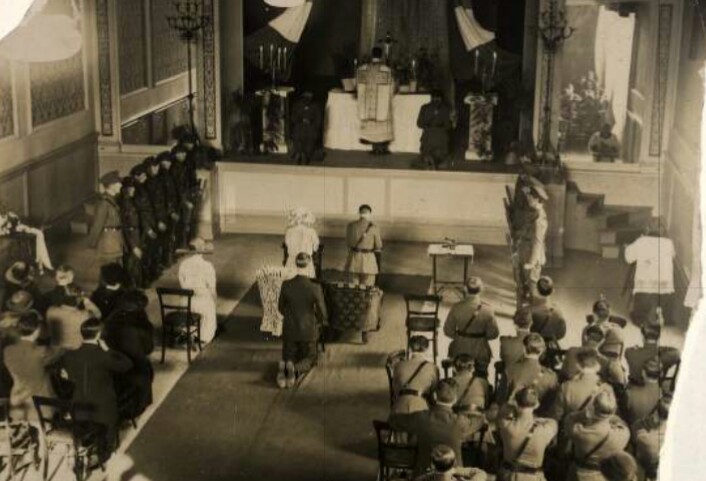
On the 8th of October 1922 Free State Major General Emmet Dalton married his fiancée Alice Shannon in the Imperial Hotel. The wedding took place in the Clarence Hall in the hotel, not in a church due to security reasons.
 Dalton's 21 year old bride was from Phibsboro Dublin. Alice had travelled to Cork by sea because  it was safer and faster due to the roads and rails which suffered disruptions due to the ongoing war.


                                                     The bride and groom

24 year old Dalton was the Free State forces military operations director and in Cork the Imperial Hotel became his headquarters after he landed troops there by sea in August 1922. 


A car waiting for General Dalton at the side door of the hotel.


When Michael Collins arrived in Cork in August 1922 he stayed in the Imperial Hotel and Dalton accompanied The Big Fella when he left the hotel on the morning of August 22nd. On the route back that night they met an ambush in Beal na mBlath and the rest as they say is history. 


Emmet Dalton and Michael Collins


The Dalton wedding in October 1922 was attended by several Free State officials and clergy. The wedding was for many a break from the realities of conflict but, by evening an incident in the hotel would end the day on a sour note.


The wedding of Emmet Dalton and Alice Shannon in the Clarence Hall, Imperial Hotel.


With any wedding comes a good flow of booze and this wedding was no different. The Free State soldiers based in the Imperial Hotel toasted the wedding of their general with generous amounts of alcohol and by late evenng a whiskey soaked  argument broke out between two soldiers. 


Sergeant Charles Kearns and Private Andrew Rooney had been, with the rest of the soldiers in the Imperial Hotel, enjoying the wedding day but after one too many "toasts" the two men got into an argument with each other  and had to be separated by their comrades.  
The two fueding soldiers went their separate ways and no more was thought of their drunken squabble until a few hours later a gun shot was heard in the guard room in the hotel. 


Civilians and Free Staters outside the entrance of the Imperial Hotel


Rooney and Kearns bumped into each other in the guard room where the argument re-ignited, this time with deadly consequences. 
Rooney drew his pistol and shot Kearns dead. Rooney was arrested and later court martialed. He was sentenced to death but, General Richard Mulcahy commuted the sentence to five years hard labour. 


Kearns who was originally from Crocus Street in West Belfast was buried in the Free State plot, near where Michael Collins was buried, in Glasnevin Cemetery. He was a single man and his mother was awarded a gratuity of £50 following his death in Cork's Imperial Hotel.


Grave of Emmet Dalton in Glasnevin Cemetery


General Dalton was reportedly incensed by the drink fuelled shooting on his wedding day but by then his concerns had been gathering regarding the state of affairs within the Free State Army. 
Two months after his wedding Dalton resigned from the army, dissatisfied with the executions of Republicans and the route away from Michael Collins' ideals which the Provisional Government took. Dalton would go on to work in the film industry in the US and founded Ardmore Studios in 1958.
 He died on his 80th birthday in 1978 and was buried with military honours near Michael Collins in Glasnevin Cemetery.


A silver serving tray which was gifted to Dalton and his bride by - " his brother officers IRA engaged with him on active service in Cork". 
Today the tray is in the Lord Mayor's office in Cork City Hall.