Thursday, May 14, 2020

Parnell Bridge - January 4 1921


It was a cold dark Wednesday evening in January 1921 when the First Cork Brigade of the IRA launched a daring ambush in the city. The Union Quay Barracks was the city's HQ of the RIC. At 7:30pm a foot patrol left the barracks and headed in the direction of Parnell Bridge when a number of hand grenades were lobbed their way. 


Union Quay Barracks, the tall building on the right. 

The Union Quay Barracks today, now apartments. 


One sergeant and nine constables left the barracks on their usual nightly patrol which took them up the quay and across Parnell Bridge. A dozen or so IRA volunteers were waiting for them in the ruins of the city hall, burned a year previously. When their quarry came into sight they sent a number of grenades in their direction. 


The ruins of Cork City Hall. 


As the grenades exploded the ambushers then advanced with their guns. Meanwhile across the river, a car with a Lewis s gun attached, had parked up at Morrison's Island and fired across at the RIC who came out of their barracks after hearing the explosions. 


The car with the machine gun was parked at the green X. The red line indicates the patrol which came up the quay from the barracks and was hit with grenades as it turned onto Parnell bridge. 


The RIC men who escaped the grenades drew their guns and fired back at their ambushers. Unfortunately a number of civilians were hit in the crossfire. Two merchant sailors from Wales were hit on their ship in the river. Mary Mulcahy a young local girl was hit with shrapnel as she crossed the bridge. Kate Bourke was also hit and George Boucher was hit by a bullet in his knee but, they all survived and were later compensated. 


Parnell Bridge from South Mall with City hall in the background. 


The ambush at Parnell Bridge lasted approximately ten minutes. Six of the RIC patrol were hit. None of the IRA party were hit. When the engagement ended those on foot fled to various safe houses across the city while the car with the lewis gun sped off to a safe house in Ballincollig. 


An IRA volunteer with a Lewis machine gun, similar to the one used at the Parnell Bridge ambush. 


 Constable Francis Shortall from Tipperary was 38 and was a captain in the Irish guards during WWI in which he served as an interpreter as he was fluent in French and German. He died from wounds he received three days after the ambush.
 
  Constable Thomas Johnston was a 19 year old Cavan man who worked as a hospital porter before joining the RIC and was posted to Cork. He died from shrapnel wounds 17 days after the Parnell Bridge Ambush.  


Witness Statement of Commandant Michael Murphy. 


Cork Lord mayor Donal O'Callaghan receiving the key of Union Quay Barracks in 1922. 


Monday, May 11, 2020

St Patrick Street - February 28 1921


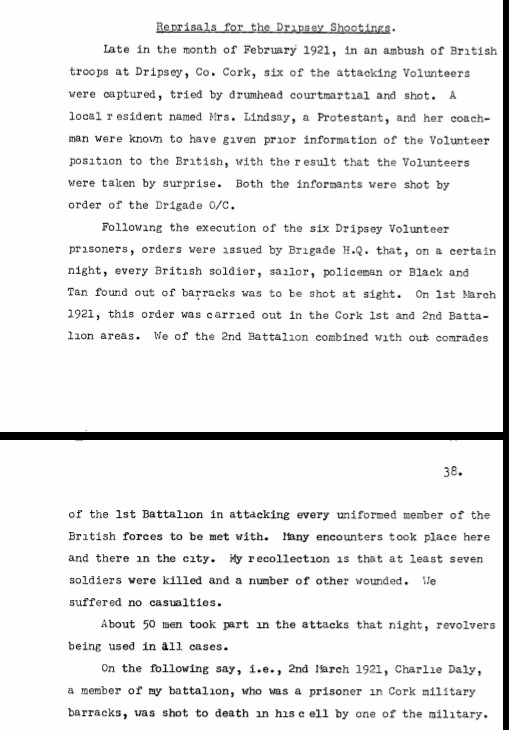
Following the foiled Dripsey ambush in January 1921, the IRA volunteers who were captured there by crown forces were executed a month later at Cork County Gaol (Today's UCC). 


                                  Cork County Gaol, today part of the UCC campus. 


Large crowds assembled outside the gaol near the Western Road on the morning of the executions. The widow of Tomas MacCurtain set up an altar and led the assembled in prayer. From 8am a volley of shots were heard at 15 minute intervals. 


Ballad composed in 1921


Volunteer Thomas O'Brien aged 20 from Model Village, Volunteer Dan O'Callaghan aged 22 from Dripsey, Volunteer John Lyons aged 27 from Aghabullogue, Volunteer Tim MacCarthy aged 21 from Donoughmore and Volunteer Pat O'Mahoney aged 30 from Berrings were executed and buried in the prison yard. 


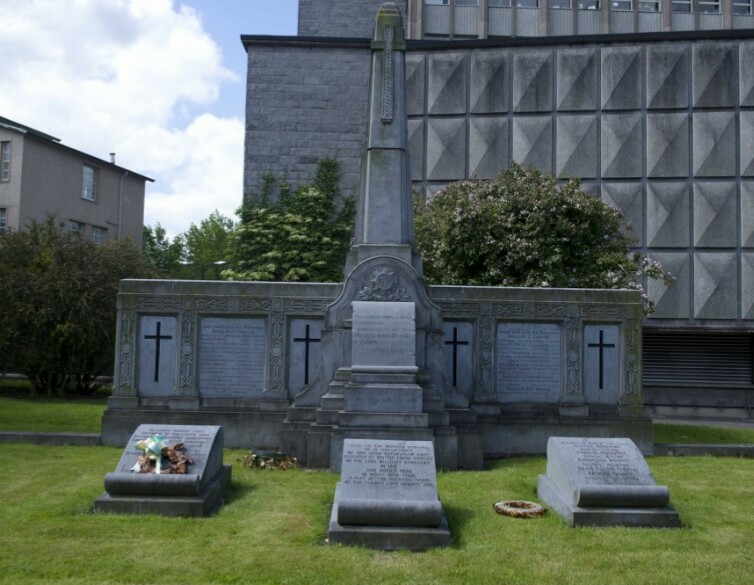
Today a memorial marks the grave of those executed at Cork County Gaol now UCC.


Following the executions the First Cork Brigade carried out reprisal shootings across the city that night. The shooting party met in a premises on Oliver Plunkett Street where an accident saw the removal of one of the party. 
As the IRA men were preparing their weapons Sean Lucey was accidentally shot in the leg. He was taken to the South Infirmary where he recovered. This accident did not derail their plans and at 6pm the party set off, each man armed with a revolver and revenge.


Memorial at the Dripsey Ambush site. 


 The first shooting took place near the military barracks just after 6.30pm when Signaller Bowden of the Royal Corps of Engineers was wounded by a number of shots fired by the IRA.  Private Whitear of the Hampshire Regiment was shot on Lovers Lane and managed to get into a nearby house where he then died.


Witness Statement of Commandant Mick Murphy.


Private Thomas Wise was standing at the ruins of Cash's which had been burned a year previously by crown forces during the Burning of Cork. He was with a lady friend when a number of men with revolvers approached and fired at him.


The ruins of Cash's following the Burning of Cork in 1920. 


Private Wise was a 30 year old from Blarney Street who joined the Munster Fusiliers before joining the Royal Irish Regiment and went to France as an army driver during the end of  WWI. In 1919 he was back in Cork with the Motor Transport Company at Victoria Barracks. When he was shot he managed to run down a nearby  laneway known as Conkleys Lane where he then collapsed and died. 


Thomas Wise


Cash's following its rebuilding in the late 1920s.


The shooting party then moved up Pana and shot Private William Alfred Gill and private Bettesworth at the top of Academy Street. Gill was a 21 year old Londoner and a member of the Hampshire Regiment who served in Germany at the end of WWI. He and Bettesworth were killed instantly as they stood in their uniform at the junction of Academy Street and Patrick Street. 


Private Gill.


More shots were fired at British uniforms on the Grand Parade and South Mall as the IRA shooting party moved through the city. On Infirmary Road Lance Corporal Beattie was shot dead while Corporal Hodnett of the Royal Army Service Corps was killed by shooters on the Douglas Road. 


Pana in the early 20th century.


The shootings ended sometime after 10pm.


Friday, May 8, 2020

North Gate Bridge - July 18 1920


It was a hot Summer Saturday night in Cork city when trouble broke out between retired and serving members of the British army. It began with the death of 42 year old James Bourke from Victoria Terrace, Blarney Street. 


James Bourke


Bourke was with other men at North Gate Bridge, making his way home from the pub. They got into an argument with two off duty soldiers and constables from nearby Shandon Street Barracks arrived to intervene but then, a lorry of the dreaded South Staffordshire Regiment who were on a curfew patrol arrived and used brutal force to disperse the men. 


North Gate Bridge in the early 20th Century. 


The South Staffordshires fired their guns and then proceeded to bayonet those who did not disperse. Mr Bourke, a former member of the Munster Fusiliers, recieved a bayonet in his side which ultimately killed him. 


View of North Gate Bridge from the south.


The following evening a group of angry friends of Mr Bourke aided by ex-members of the British forces gathered at the scene of his death at the North Gate Bridge. The night before as Mr Bourke lay dead someone had written, in his blood, on the quay wall where he was murdered: "RIP killed by military of Staffordshire Reg." It was still there when the angry group gathered the following evening. 


North Gate Bridge today.


The military arrived to disperse the crowd that had gathered at the bridge, and did so with brutal force. An armoured car arrived and unleashed a hail of bullets. As people screamed and scattered in all directions, William McGrath, a 34 year old from Coach Street and a former member of the Leinster Regiment, spotted a terrified girl huddled at the top of Angel Lane, off North Main Street. To save her from being trampled by panicked crowds or shot by the military, Mr McGrath scooped her up with his one arm (he lost the other one during his service in WWI) and managed to place her safely into a nearby house. 


Angel Lane, off North Main Street. 


As Mr McGrath emerged from Angel Lane and back onto North Gate Bridge a bullet from a military armoured car machine gun cut him down. William McGrath worked as a docker following his return from WWI with one arm and his widow was later awarded £1,500 compensation and each of his three children were awarded £300. 


William McGrath.


James Bourke who's murder sparked the outrage was buried at Curraghkippane cemetery following a large funeral from the North Cathedral. Former comrades carried Mr Bourke's coffin while the cortege contained  5,000 members of the Discharged and Demobilised Soldiers and Sailors Federation. One of the pallbearers was from it's Bandon Branch - Tom Barry, who served with the Royal Field Artillery in WWI. Four months later he would lead the IRA's attack against crown forces at Kimichael. 


Wednesday, May 6, 2020

87 St Patrick Street - November 18 1919


T.W Murray & Co. Ltd is one of the oldest established businesses on Cork City's main thoroughfare. 
The gun shop drew the interest of the Cork IRA in the early days of the War of Independence and on a Winters night in 1919 they decided to go there for a "shopping spree"!


Murrays on Pana, still trading today.


A party of ten IRA volunteers from the 1st Battalion Cork No.1 Brigade were involved in the raid on Murrays gun shop. 
Two men watched shop manager George O'Connell close the premises at 6pm and head for the tram home. The two IRA men followed him onto the tram and as they reached Commons Road the two IRA men took Mr O'Connell off the tram at gun point. 


The shop manager was taken to Lucy's Field where two other IRA men were waiting with ropes. They tied up Mr O'Connell and took his keys to the gun shop. While two IRA men stayed with O'Connell, the other two headed back to Patrick Street with the keys. 


Murrays on the left of this early 20th century postcard.


A car waited outside the shop while the IRA men were busy removing guns and ammo from it. The arms were wrapped up in canvas and taken from the shop to the waiting car. 
Among the guns taken were 7 single barrel shotguns which had been dropped into the shop for repair  by a local Anglo landlord. One of the shotguns was an antique priced at £500!


Even though there were four RIC men patrolling Pana that night they failed to notice the raid taking place at Murrays gun shop! 
The raiders took as much as they could and loaded up the car which then drove off unnoticed in the direction of Blarney where the arms were stored in an arms dump there.
 At 11pm Mr O'Connell was let go. He dashed back to the premises and found most of it's contents gone. He reported the raid to Tuckey Street RIC station and had less than kind words for the constables who failed to notice the raid!


Witness Statement from Lieutenant Stephen Foley, G Company, 1st Batt, Cork No.1 Brigade IRA.

Thursday, April 30, 2020

St Patrick Street - April 21 1923


It was Saturday night and a number of youths were hanging out near the ruins of the Munster Arcade, burnt by British forces three years previously. A Free State officer walked past the youths who turned on him and then, all hell broke loose. 


The Munster Arcade on the right, Cash's in the background, in 1927 after the street was rebuilt. 


As the youths attacked the Free State officer he drew his gun and let off a round of bullets. One or maybe two of the youths also had arms and they returned fire. Just as this scrap was happening, 42 year old William Murphy and his brother were approaching from Robert Street.


      Robert Street, at the side of Penney's, today. The scene of the gun fight in 1923. 


A bullet hit William Murphy in his side just as he turned the corner from Robert Street onto Patrick Street. The Murphys Brewery worker was returning back to his home on 98 Street after an evening out with his brother Jeremiah.


         Then and Now: 98 Street where William Murphy lived.


Jeremiah held his brother William and managed to carry him from the scene of the shooting up the street towards the Victoria Hotel where William then collapsed in its doorway. 


 The Victoria Hotel, with the canopy, where the Murphy brothers ran to, from the top of Robert Street (at the corner of Penney's today!) 


William was placed on a side car outside the hotel and he was taken to the Mercy Hospital where he died hours later. 


Monday, April 27, 2020

St Patrick Street - December 8 1922


December 8th was not only an important date in the church calendar but it was also a day which saw an influx of shoppers into cities to do their Christmas shopping.
 In Cork in 1922 a Civil War was in full swing and the rebel city was partially in a state of wreck since it was torched by Crown forces two years previously but - such circumstances did not deter the throngs of festive shoppers venturing into the city that day.


                View of Patrick St from Daunt Square: Thompsons Cafe seen in the middle.


That day a car of Free State officers left the County Gaol (now UCC)  and headed for Patrick Street. The car parked outside Thompson's Cafe/Liptons shop and just as the driver cut the engine a man appeared from across the street and hurled a mills bomb at the Free State car. 


                                               Liptons on Patrick Street in the 1920s.


The bomb bounced off the car mud guard and rolled towards Lipton's window where it smashed through and exploded. 


                         Boots now occupy the site of Liptons and Thompson's Cafe.


The bomb caused damage to Lipton's and Thompsons Cafe nextdoor. Ten civilians were injured and one died. 
24 year old Katherine Feehely from Bachelors Walk was in Thompsons Cafe when the bomb exploded, she died days later from injuries she received . 


Miss Feehely