Friday, April 5, 2019

Castle Street - March 2 1921


70 year old Denis O'Brien, who worked as a coachman was trying to make his way back to his lodgings at 397 Blarney Street on the night of March 2nd 1921. Cork was under martial law and unfortunately for Mr O'Brien he was on the streets during curfew hours.


Castle Street today.


As he was making his way down Castle Street, heading towards North Main Street, a patrol of soldiers from the Hampshire Regiment emerged from Paul Street and upon spotting the hunched figure trudging up Castle Street they called on him to halt.


Either Denis O'Brien failed to hear the order or perhaps he just ignored it but what is certain is that a young private took aim and shot at O'Brien who fell dead on the spot. The Hampshires were notorious for their behaviour on the streets of Cork. Many civilians fell to their bullets, including the unfortunate Mr O'Brien. 


The Hampshire Regiment leaving Cork (Collins) Barracks at the end of the War of Independence.


Thursday, April 4, 2019

Caroline Street - March 1 1921


On the first day of March 1921 Lieutenant Hammond from Victoria Barracks was searching people outside the door of the General Post Office at 4pm on George Street (today Oliver Plunkett Street.) Hammond, who was an Inteligience Officer, noticed five men run past. He pursued the men up Caroline Street where he saw them run around the back of No. 13.


Hammond entered a building next to No.13 and got up to the roof from where he could spy the five men hiding in the yard next door. Hammond fired on the men who in turn fired back.


The five men then entered the back door of No.13 Caroline Street which was serving as a boarding house and Hammond continued shooting at them. One of those lodging there was 30 year old Daniel Casey, an unmarried man who worked as a docker. Casey came out of his room to see what all the commotion was and just as he did, a bullet from the gun of Hammond smashed through a window and hit Casey in his chest. The docker stumbled back into his room and from there he was taken to the North Infirmary where he died.


The landlady of No. 13 Caroline Street later recalled in a military inquiry that she heard gun fire and smashing of glass. She stated how she heard Casey shout out "I'm shot! I'm shot!!" She also claimed that she saw Casey's shooter, Hammond, on the roof of a store opposit the back yard of her house. The inquiry came to the conclusion that Casey's death was "as a result of misadventure."

Tuesday, April 2, 2019

13 Brunswick Street (4 St Augustine Street)


Today the laneway that runs at the back of St Augustine's Church connecting the Grand Parade and South Main Street is an uninviting dark corridor but during the War of Independence a small unassuming newsagents shop run by two sisters was the beating heart of the IRA's intelligence centre.


Before it was St Augustine Street, it was called Brunswick Street and at No.13 Brunswick Street was the shop run by Nora and Shelia Wallace. When the street name changed, the shop address became No.4 St Augustine Street!
The Wallace sisters sold newspapers and tobacco and political pamphlets of the republican and labour movement. The sisters were active in the revolutionary movement, spearheading the Irish Citizen Army on Leeside.


                                        The Wallace sisters


Information board at Cork Public Museum 


The newsagents became the one stop shop for the Cork IRA Intelligence. It played the unioffical role of IRA GPO! Messages were dropped and picked up while a back room served as a meeting room for the top brass in Cork's Republican movement.
James Connolly visited the shop in January 1916. He was in Cork to deliver a lecture on street fighting at the Gaelic League HQ at No.3 Fr Matthew Street. Countess Markievicz also visited the Wallace sisters and Trade Unionist Cathal Shannon lodged in a room above the shop for some time.


                  4 St Augustine Street, before it was demolished in the 1970s.


On the night of March 19th 1920, Lord Mayor Thomas MacCurtain paid a visit to the shop before going home to Blackpool. He was murdered hours later by policemen in his home. Terence MacSwiney was also a frequent visitor to the Wallace Sisters shop and often played the role of shopkeeper if the sisters were tending to other business.


Shelia was a staff officer of the Cork No.1 Brigade, one of the very few females in Ireland to hold that title. The shop came under the eyes of the authorities in 1921 and the sisters were ordered to shut down their premises in May 1921. They were also expelled from the city.


With the truce in Summer 1921 came the reopening of the shop and on July 12th, a party was held for the grand reopening. Among those celebrating the reopening at the Wallace sisters shop was Gen. Tom Barry.


Following the bitter treaty split, the sisters remained faithful to the Republican movement and for this they paid with regular raids from Free State forces. Raids would continue well after the Civil War when it fell upon the local guards from the Bridewell to arrive at the small shop and "do it over".


A Garda raid on the Wallace shop in April 1926 was raised in the Dail.


In later years the sisters moved from their dwelling above the shop to the Old Youghal Road but they continued to trade on St Augustine Street. Shelia died April 14th 1944. Nora continued to run the shop until bad health saw her close the premises in 1960. Nora died September 17th 1970 and was laid to rest next to her sister at St Finbarrs Cemetery.


Sunday, March 24, 2019

Broad Street - November 17 1920


High winds and heavy rain swept through Cork city on the night of November 17th 1920 when bloodshed soaked the Marsh area. 
This working class area around the St Francis church teemed with tenements and hived with republican activity. 
At 11:45pm two RIC men left their barracks on Tuckey Street and ventured into the Marsh area to carry out a night of murder and mayhem.


                            Broad Street in the early 20th century.


Earlier that evening Sergeant James O'Donoghue of Tuckey Street barracks was shot dead by the IRA on White Street. His enraged fellow policemen sought revenge and did so under the cover of darkness that night.  

The strange thing is, Srgt O'Donoghue often found himself at odds with his fellow RIC men, especially those newly recruited into the Auxiliary Division. He hated their thuggish behavior and he was on friendly terms with members of the local Republican movement, infact his killing was not sanctioned by the IRA and those who carried it out were condemned by senior IRA officers. 


Sergt. O'Donoghue


Due to curfew no street lamps lit the streets of Cork and the two RIC men found their way to the Broad Street tenements with flash lamps. Wearing long over coats and goggles, they burst in through the door of no.2 Broad street and began shooting in the Coleman family dwelling. Stephen Coleman was shot but survived. 


The RIC men then ran upstairs where they kicked in the door of the Hanley's home and encountered 17 year old Patrick Hanley in his bed. Young Hanley put up his hands, asked the policemen not to shoot and informed them he was the sole bread winner in his family for his widowed mother and sisters. The RIC men raised their revolvers and a bullet pierced Hanley above his heart, killing him instantly.


Memorial picture for Patrick Hanley.


Witness account from the military archives


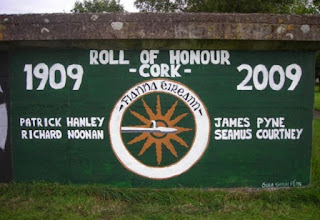
Patrick Hanley was a member of  Fianna Eireann and he was laid out in Saint Peter and Paul's church in his uniform as his comrades formed a guard of honour for his funeral. He was laid to rest in the Republican plot in St Finbarrs cemetery.


Grave of Patrick Hanley, St Finbarr's Republican plot.


When the two RIC men finished their deed in no.2 Broad street they casually walked around the corner to no. 17 Broad Lane. They kicked in the door and shot 16 year old Charles O'Brien, another Fianna scout. 
O'Brien was hit in the face by a bullet which would leave him disfigured for life. He lost an eye, part of his jaw and recovered in secret at the nearby Mercy hospital. Upon his discharge after several months he did so in secret, leaving the hospital inside a laundry basket!


             Modern day Broad Street, very different from what it was 100 years ago.


After shooting young O'Brien the callous RIC men then encountered 28 year old Eugene O'Connell on the landing and fired at him. A bullet struck O'Connell but he managed to crawl back into his room where his wife was in bed with their baby.


O'Connell and family


 The RIC men followed O'Connell and fired more bullets into him, killing him, then one of them raised their revolver at O'Connell's wife who was screaming, along with her baby, in bed. They hesitated before deciding  to spare Mrs O'Connell her life. When leaving no.17 Broad Lane, the policemen flung a bomb into its entrance injuring another occupant, Mr Collins.


                     unveiled in 1957 by the Lord Mayor of Cork at Hanley Buildings, Grattan Street, a plaque commemorating Patrick Hanley.


O'Connell was an IRA Volunteer with the First Cork brigade but had served with the Munster fusiliers during WWI. He was buried in St Joseph's cemetery.


Grave of Eugene O'Connell.


   Maud Gonne MacBride visiting the scene of the Broad Street Massacre.


Mural at Cork's Lee Fields, later removed by Cork Council.


Nobody was brought to account for the night of terror in the Marsh. The tenements are no more, but a plaque commemorates Patrick Hanley on the site where a November night brought murder and mayhem to the area. It is, to date, the only plaque to mark that dark night in 1920.


Wednesday, March 20, 2019

Bridge Street - September 14 1922


It was Thursday evening when two Liverpool lads were sauntering the streets of Cork. They were sailors freshly docked in Cork port and as they strolled up the quays towards Patrick's Bridge little did they think that one of them would not be making it back to ship that night.
Edward Williams was an 18 year old merchant sailor. He was working onboard a Cork Steam Packet ship as a wireless watcher. He and his friend, John William Cove, also 18, reached the corner of Patrick's Bridge and Bridge Street when they met some local girls.


The two Liverpool sailors, who were in uniform, were busy chatting up the girls and did not notice a man appear from a nearby pub brandishing a revolver. He fired at the two sailors before fleeing down the quays. A bullet hit 18 year old Edward Williams, killing him instantly.


Hours earlier a free state patrol had been fired on in that same area. Tension was at an all time high on the streets of Cork and perhaps through reckless youth, the two Liverpool lads did not take heed of the dangers.