Tuesday, July 28, 2020

Turners Cross


Across the road from the Church of Christ the King at Turners Cross you will find a large white plaque dedicated to the IRA Volunteers of D Company, 2nd Battalion First Cork Brigade and two D Company members who lost their lives - Charles Daly and John O'Brien.


Witness Statement of D Company Vol. Robert Ahern


There are two other similar plaques located on the south side of the city - at Phairs Cross and at Friars Walk. These plaques were erected by old comrades of the 2nd Battalion Cork IRA in the decades after the war. 


The plaque is on the grey house on the right, directly across from the church. 


31 year old Charles Daly was residing at 5 Glenview Terrace South Douglas road at the time of his death. In June 1921 he was captured at O'Sheas pub in Waterfall. Captain Leo Murphy was shot dead during the round up there and Daly was taken prisoner to Victoria (Collins) Barracks. 


O'Shea's Pub Waterfall after the roundup.


Daly was tortured in the barracks and his body was later dumped in the woods at Vernon Mount.


He had six bullets in his body, five bayonet wounds, a broken eye socket, crushed skull, broken ribs, broken fingers, broken arm and broken leg. Daly worked as a clerk at the Cork Gas Office on South Mall and was buried at the Republican plot in St Finebarrs Cemetery. 


John (JaƧk) O'Brien came from 34 Maiville Terrace Evergreen road and was shot dead fighting against Free State forces outside Blarney village in September 1922. 


21 year old O'Brien worked as an engineer at Rushbrook docks and was buried in the Republican Plot St Finbarrs cemetery. 


Aerial view of Turners Cross 1930s.


Monday, July 20, 2020

Washington Street - April 12 1921


At 10 o'clock on the morning of April 12th 1921 William Kenefic was standing at the corner of Anne Street and Washington Street. He was a 49 year old married man from Morris's Lane on the city's northside and worked as a cabman for Lynch & Sons which was based on Hanover Street. 


Today: Anne Street/Washington Street. 


Today: Morris Lane, which ran between Blarney Street (next to the Post Office) and Boyces Street. 


Unfortunately for Mr Kenefic he was in the wrong place at the wrong time. Just as he stepped out from Anne Street making his way across the road to his place of work on Hanover Street, two lorries of British Soldiers drove by and an explosion occurred. 


                      The junction of Anne Street, on the left, and Washington Street.


A grenade was hurled at the passing lorries by an IRA Volunteer on foot. The grenade did not land in any of the lorries, instead it bounced off them and exploded on the footpath injuring five people. One of them was Mr Kenefic who sustained severe shrapnel wounds to his chest. 


Modern day Anne Street/Washington Street. 


The wounded civilian was taken to the nearby Mercy Hospital but, he died a day later. Mr Kenefic's widow and five children were later compensated £500. 


Tuesday, July 7, 2020

Union Quay - February 22 1921


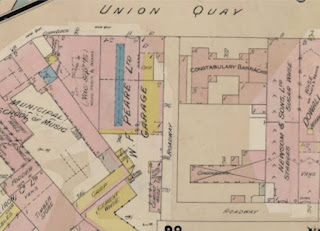
The Headquarters of the Royal Irish Constabulary in Cork City was based in a big brooding building on Union Quay. From here the rule of the crown was administered over the rebel streets of Cork. 


The Union Quay RIC barracks, later Garda barracks. 


In January 1921 the IRA launched an ambush on a patrol which marched out from the barracks and over nearby Parnell Bridge. The barracks also became the destination for many an IRA prisoner. One was Tomas O' Maoileoin alias Sean Forde. After escaping from East Clare he was caught in Cork and sent to Union Quay barracks where the constables used him as a football. His time in the dreaded Union Quay Barracks saw him lose not only consciousness but also his teeth. 


Union Quay today. The barracks, marked, now the site of an apartment block. 


There were a few good natured and friendly RIC men in Union Quay such as constables Carroll, McNamara, Sinnott and Kelly who passed on information to the First  Cork Brigade intelligence unit. 


The "men of law" posing on Union Quay. 


Group of RIC men outside Union Quay Barracks. Picture taken during the Truce period in 1921. 


In February 1921 a tragedy in the barracks saw the life of a young local lad ended  through the recklessness of a new recruit.
 17 year old George Fletcher lived with his grandmother and aunts at 21 Kyle Street. His grandmother Sarah Carey and his aunts were dressmakers and young George worked as a messenger boy in the Union Quay barracks. 


The home George lived in is now demolished, it was located where the green fence is on the right. 


On the night of February 22nd 1921 George was collecting washing from the sleeping quarters. As he then entered the guardroom he was shot by constable Joseph Prendergast. 


Aerial view of Union Quay, the barracks on the bottom left.  


The Union Quay barracks on the bottom left. 


The young messenger boy was hit in his groin and was moved to the North Infirmary where he died three days later. 
Constable Prendergast was court martialled and acquitted. Prendergast was a new recruit from Belfast. He was prepping his lee enfiled rifle before going out on patrol. When George Fletcher entered the room Prendergast recklessly let off his loaded rifle, thus ending the life of the teenager from Kyle Street.  He was buried in St Josephs Cemetery, Ballyphehane. 


Lord Mayor O'Callaghan receiving the keys to the barracks in 1922. 


The Union Quay Barracks were transferred to the Free State following the 1921 treaty and later was used as a garda barracks. Today, the building is no more, it is a block of apartments where residents have over the years seen a ghostly figure of a teenage boy.....


Wednesday, July 1, 2020

Victoria (Kennedy) Quay - September 3 1920


Commandant Michael Murphy led 50 volunteers of the IRA First Brigade on an all night raid on the American Oil Company depot at Cork's docklands in September 1920. 


Victoria Quay in the early 20th century.


The raid began on that autumn night at 8pm when Commandant Murphy led his men in the operation which saw the removal of gallons upon gallons of petrol. The petrol would be used for bombs in ambushes etc.


Witness Statement of Comd. Michael Murphy. 


Men were posted at sections of the quay and on Albert road and Centre park road to keep watch while others busied themselves in the oil depot filling barrels and tins with their bounty. 


Today it is known as Kennedy Quay.


Volunteers in cars, vans and even donkey and carts came to collect the filled tins and barrels which were then taken to the nearby Ashe Grounds, which was the Cork IRA's biggest arms dump located within the Cork Showgrounds! 


The operation ended just before 7am. It was done successfully and all volunteers got away just before a lorry of tans appeared on the scene! 


Irish Navy's L.E Eithne at Kennedy (Victoria) Quay.

Wednesday, June 24, 2020

Tower Street - July 12 1920


 Tower Street was once the site of Cat Fort, an old British militia barracks built in the 17th century as a twin defence barracks to Elizabeth Fort on Barrack Street. In 1920 it was being used by the Young Men's Christian Association (YMCA) as their store depot. This organisation was Unionist in it's inclinations and the Cork IRA suspected a spy network was working within its fold to decimate the Republican movement on Leeside. 


Old map showing Elizabeth Fort on Barrack St and Cat Fort on Cat Lane which was later renamed Tower Street. 


The YMCA became a target of the Cork No.1 Brigade and on the night of July 12th 1920 it's store depot at Cat Fort was raided by members of the First Brigade but, in the process a woman died.


Mary Anne Ward was a 61 year old who was living in the main guard house in the grounds of Cat Fort with her husband Arthur who worked there as YMCA caretaker. Mary, who gave birth to 15 children of 9 survived, previously lived with her family at No. 42 Douglas Street. When her husband retired from his work as an auctioneer they moved to Cat Fort when he took up what was to be a light position as YMCA caretaker. 


The Ward home on Douglas Street, the green house on the left.


It was Sunday night just before midnight when approximately 20 volunteers raided Cat Fort. They took items such as a cinema projector and some British Army issued provisions. Before setting alight to the sheds and outhouses the Volunteers ordered the Wards to vacate the premises. As they were crossing the barrack square Mary Ward became distressed and collapsed. She was taken with the aid of her husband and some volunteers from Cat Fort to the public house across the street where she took her last breath. 


"Cat Fort Car Park" across from Ma Dulleas pub now occupies the site of the long demolished Cat Fort. 


In the inquest which followed Mrs Ward's death it was discovered she was suffering from heart disease and her cause of death was a cardiac attack.


Free Staters outside the YMCA office on South Mall.


Tower street was previously known as Cat Lane after the fort there. In 1865 local merchant Michael Callanan built the tower which now gives the street its name. His intentions were to have the tower as a focal point in a grand garden and race track in the area but, his plans were never fully realised and all that remains today are the stone walled gates and the tower which oversaw the raid on Cat Fort that Summer night in 1920. 


Monday, June 22, 2020

Sundays Well - May 15 1921


Father James O'Callaghan was a native of Templemartin Parish near Bandon, West Cork. He was ordained in 1908 and was an influential figure in the Irish language movement in Cork. In 1921 he was a newly appointed curate at the Church of the Most Precious Blood Clogheen when he was murdered by members of the crown forces. 


Fr O'Callaghan was lodging at the home of Sinn Fein TD Liam de Roiste at No. 2 Upper Janemount Sundays Well. He was staying in de Roiste's home, along with his house keeper Kate McSweeney, while waiting for his own accommodation in Clogheen to be built. 


The steep Buckston hill which leads to Upper Janemount, off Sundays Well Road.


It was around 4 o'clock on the Sunday morning of May 15th 1921 when a group of masked RIC Auxiliaries made their way up the steep Buckston Hill with murder in mind. 


De Roiste's home at Upper Janemount.


Days previously the RIC had raided de Roiste's home. They met Fr O'Callaghan and knew he was the only man in the house as de Roiste was on the run and the only other occupants were De Roiste's wife and the priest's housekeeper Kate McSweeney. 


Liam de Roiste


In the early hours of May 15th those three individuals were in the house when a loud knocking at the front door woke them. When there was a delay in answering the door the glass panels on the door were smashed and masked men burst into the house. Kate McSweeney rushed down the hall in a panic and as Fr O'Callaghan appeared on the landing the masked men produced their arms and fired. 


Liam de Roiste was elected Sinn Fein TD for mid Cork.


One bullet grazed the hand of Kate while other bullets hit Fr O'Callaghan. The masked RIC Auxileries left the scene and casually went back down into the darkened Sundays Well leaving behind a dead man of the cloth.


Today a plaque marks the home of Liam de Roiste.


Grave of Liam de Roiste at St Joseph Cemetery, Ballyphehane. 


Due to the steep incline of the area, an ambulance found it difficult to get up to de Roiste's home so with the help of neighbours the slain priest was wrapped in a blanket and carried down Buckstons Hill to where the ambulance waited. Fr O'Callaghan was taken to the North Infirmary where he later died. 


Fr James O'Callaghan was one of three priests killed by crown forces during the War of Independence. Canon Magnier was murdered by out of control British soldiers in West Cork as was Fr Griffin in Co. Galway.


The funeral of Fr James O'Callaghan was a large one, the procession included several organisations and bands as well as clergy. He was buried in the grounds of Clogheen church. Fr O'Callaghan was originally supposed to be buried in St Joseph's Cemetery in Ballyphehane but at the behest of the Clogheen people he was laid to rest there.


Grave of Fr O'Callaghan, Clogheen Church.


Liam De Roiste would go on to become a Cumann na nGaedheal TD and later lead the Cork branch of the Irish Christian Front which supported the Fascist General Franco in Spain in the 1930s. He died in 1959 and he was buried in St Joseph's Cemetery.


50th anniversary of Fr O'Callaghans death marked at his graveside in Clogheen 1971.