Thursday, January 28, 2021

O'Connell Street - May 14 1921


Just after 5pm, on a bright Saturday evening in May, seven RIC men from Shandon Street Barracks went on a foot patrol towards Blackpool. The five constables and two sergeants made their way up Great William O'Brien Street (then known as Great Britain Street) and turned onto O'Connell Street to head over to Watercourse Road. 


The junction of Great William O'Brien Street and O'Connell Street, Blackpool. 

Volunteers from the First Cork Brigade lay in wait for the RIC patrol on O'Connell Street. As their quarry came into sight a Volunteer hurled a bomb in their direction while others unleashed gunfire. In what became known as The Blackpool Ambush, four RIC men were injured and three were killed.

Constable Peter Coughlan was a 48year old  Kerryman. His legs were blown off in the explosion and he died from severe blood loss. He was buried in his native Church town, outside Killarney where his headstone is inscribed in Irish.

Constable John Ryle was also a Kerry native and the 46 year old was injured in the bomb blast. He was taken to the North Infirmary where his leg had to be amputated but, he died the following day. He buried in his native town of Tralee.

Constable Patrick Hayes was a Corkman who had 25 years service with the Royal Irish Constabulary. The 49 year old was killed instantly by the bomb blast.

The IRA volunteers managed to get away but, the crown forces carried out brutal reprisals that night in Blackpool by burning two pubs near the scene of the ambush and a number of houses on O'Connell street. 


The junction of O'Connell Street and Watercourse Road. On the right is the former workshop of famed sculptor Seamus Murphy. He set up his studio here in 1934 and one of his first commissions was the Clonmult IRA memorial in Midleton.


Wednesday, October 21, 2020

White Street - November 17 1920


Just after 6pm on the evening of November 17th 1920 Sergeant James O'Donoghue left his home on Tower Street and proceeded to walk to his barracks on Tuckey Street. 


As he walked down White Street three men hiding in the gateway of Desmond's Builders Yard emerged with pistols drawn. Shots rang out and Sergeant O'Donoghue fell dead with two bullets in his back and one in his head. 


Today - White Street, off Douglas Street.


Sergeant O'Donoghue was 46 years old and married with four children. Originally from Cahirsiveen Co. Kerry, he had 22 years service in the RIC. 


Tuckey Street RIC Barracks, across from the Freemasons Hall, today it is the Society of St Vincent de Paul. 


Sergeant O'Donoghue was not initially a target of the Cork IRA, in fact he had been well liked in the locality and was known to rebuke Tans in his barracks who acted like thugs. When news of his killing spread across the city many people thought it was the Tans who killed him.


White Street, early 20th Century. 


O'Donoghue's killing was carried out by IRA Volunteers Charlie O'Brien and brothers William and Justin O'Connor. Senior officers in the First Cork Brigade were furious with them. It was not sanctioned and they sent a letter of apology to O'Donoghue's widow.


Sergeant O'Donoghue and his wife.


Sergeant O'Donoghue was buried in his native Cahirsiveen. His heartbroken wife never recovered from the shock of his killing, she died three years later. 

The killing of O'Donoghue later sparked off a reprisal when a number of RIC and Tans terrorised the tenements of Broad Lane where a number of IRA members lived. They killed and maimed in the name of their dead colleague but, it was a reprisal O'Donoghue certainly would not have wanted and his was a killing that should not have happened. 


Friday, October 16, 2020

Washington Street - October 18/22 1922


For a few days in October in 1922 Washington Street played host to scenes of mayhem and tragedy.


On the 18th of October 13 year old Ellen 'Lily' Gallagher left her home on the Western Road and  was walking along Washington Street with a friend when a grenade was thrown at a passing Free State Crossly Tender. It bounced off the vehicle and landed by the Lee Boot Factory just as the two girls were walking past. It exploded and injured them both. Lily Gallagher had head injuries so severe she died four days later in the Mercy Hospital. Her friend survived. 


The old Lee Boot Factory, the large red brick building on Washington Street.


On October 22nd another incident happened near the same spot on Washington Street when a Free State Crossely tender crashed into a horse & trap. 


Confusion reigned as gunfire was heard near the Court House. A Free State crossly tender sped from the scene of the gunfire and at full speed hit a horse & trap outside the entrance to the Lee Boot Factory injuring its passengers and killing one - David Nolan.


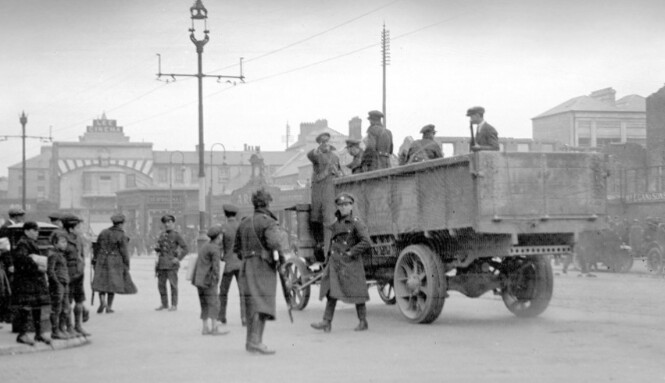
Free Staters in their lorry on Patrick Street 1922.


Mr Nolan worked as secretary in the Lee Boot Factory. A married man with children from Homeville on Magazine Road, he was seriously injured and died four days later.


Thursday, September 24, 2020

5 Marina Terrace


Seamus Quirke lived with his family at Marina Terrace before moving to Galway where the 23 year old was killed in brutal fashion by the crown forces. 


Seamus Quirke in uniform.


Quirke joined Na Fianna Eireann as a teenager  and later joined IRA H Company 2nd Battlion Cork No.1 Brigade. The son of a jeweller, he took on his father's trade and went to Galway where he worked in O'Donovans Jewellers on William Street. 
Upon relocating to Galway he joined the 1st Battalion  of the Galway City Brigade where he became adjutant.


Marina Terrace, near Albert Road, Cork's docklands.


On the night of September 8th 1920 Constable Edward Krumm was on a drinking spree in pubs across Galway. Sporting the mismatched uniform of black and kaki, Krumm was a new recruit to the RIC - better known as a Black & Tan. 

Krumm, a native of Middlesex and a veteran of WWI, was in a pub making a scene showing off his shooting skills with a row of bottles behind the bar. He then met up with a fellow tan and the two went to the railway station where they harassed passengers coming off the midnight mail train. At the station were a group of IRA men who were waiting for arms due to come in on the train from Dublin. When Krumm drew his pistol and began shooting above the heads of passengers disembarking the train, IRA Volunteer Sean Mulvoy sprung into action and wrestled Krumm to the floor. During the struggle both Krumm and Mulvoy were fatally shot. 


Funeral of Mulvoy and Quirke, Galway Cathedral.


When news reached Krumm's colleagues at Eglington Street Barracks they set out for revenge. They took to their armoured cars and tore through the city, shooting wildly and looting shops and pubs. During their ramage they called to the lodgings of young Seamus Quirke at New Dock. 


Quirke in coffin


The tans and RIC burst in Quirke's door and dragged him from bed. They then took him quayside and lynched him from a lampost before shooting 11 bullets into his body. Thinking he was dead, the tans and RIC left and went off to continue their night of terror in the city of tribes. 

Despite being half hanged and shot 11 times, Quirke managed to crawl back towards his lodgings and slumped in it's front door. Neighbours came to his aid and Fr Michael Griffin arrived and stayed with Quirke until he drew his last breath as dawn was breaking over the River Corrib. Fr Griffin would suffer the same fate as Quirke just two months later when he was taken from his home by tans and brutally murdered.


Grave of Quirke, St Finbarrs Cemetery Cork.


Quirke had a joint funeral in Galway with Mulvoy before his remains were brought back to his native city and laid to rest in the Republican Plot at St Finbarrs Cemetery.


Wednesday, September 23, 2020

3 Pembroke Street


Christopher Lucey lived at No. 3 Pembroke Street before he went west to Ballingeary where he was killed by crown forces on November 10th 1920. Lucy was a UCC medical student and a volunteer of B Company, 1st Battalion, Cork No.1 Brigade IRA.


Chris Lucey


22 year old Lucey was the son of John Lucey of the "Lucey & O'Connell" agricultural tool merchants on Mulgrave Road. He had strong roots in Muscrai where his ancestors fought against the red coats at The Battle of Keimaneigh. Young Christopher Lucey would die not far from that famous battlesite on a cold winters morning in 1920. 


3 Pembroke Street - today known better as Counihans Pub.


Lucey was born December 21st 1897 at No. 8 Grenville Place Cork city. In 1905 his father died and the family moved across the city to Pembroke Street where Nora his mother became a vintner. Today the pub is known as Counihans. 


8 Grenville Place, red brick building on right. Located near the Mercy Hospital, Cork city.

Looking across the river at 8 Grenville Place. Originally built as Turkish Baths in the 1860s, the property was later adapted for residential use where Christopher Lucy was born in 1897. 


Lucey had spent three months in Mountjoy when he was arrested in Skibbereen in early 1920. He went on hunger strike and was released early and from there he went to Ballingeary where he joined the local IRA company and took part in various actions including the Ballingeary Ambush in July 1920. 


Irish Independent November 11 1920.


Lucey was staying with his cousins, the Twomeys, at Tuirin Dubh near Gougane Barra. By night he slept in a haggard across from the Twomey cottage. 
In the morning he would come down to the cottage to wash and have breakfast. On the morning of November 10th 1920 as Lucey was making his way down from the haggard to the cottage he noticed a lorry of Auxies coming.


The memorial which marks the spot where Lucey was shot.


Lucey ran for the cottage to warn his cousins but they had already left. With the auxies hot on his heels , Lucey ran through the cottage and out the back door. As he ran up a grassy incline shots rang out and young Lucey fell dead. He was unarmed.


The second memorial to Lucey, not far from where he was killed.
* memorial photos from the brilliant - 
https://readingthesigns.weebly.com/


The auxies who killed Lucey later boasted about it in the Market Bar in Macroom. Members of the dreaded Auxie C Company were drinking in the bar the evening after Lucey was killed. 
The barman heard them talking about it, and one particular auxie who claimed to have killed him. The barman then told local IRA men about what he heared. Weeks later, the boasting auxie was taken prisoner by the Cork No.1 Brigade and executed.


Lucey's grave at St Finbarrs Cemetery Cork City. 


Christopher Lucey was buried in the Republican Plot in St Finbarrs Cemetery. His funeral drew a large attendance but suffered harrasment from British troops.

His gravestone inscription translated:
In sweet memory of Christopher Lucy
1st Battalion
1st Cork Brigade
Who was killed by the English army in Ballingeary
10 November 1920
Jesus have mercy on him


Friday, August 28, 2020

69 Shandon Street - November 23 1920


On the night of November 23rd 1920 the loyalist Anti-Sinn Fein Society with the aid of Auxiliaries/Tans/RIC torched the Sinn Fein club known as MacCurtain Hall at the bottom of Shandon Street. 


No.69 marked - the Sinn Fein Club had rooms on the upper floors. This photo shows what it looked like before it was set on fire. 


The arson at Shandon Street was part of a week long spate of arson attacks carried out by the Anti Sinn Fein Society in Cork city. Also attacked on the same night was the Sinn Fein club on Watercourse Road and the following night the Sinn Fein rooms on Hardwicke Street also suffered from arson. 


Holly sellers at the bottom of Shandon Street in the 1920s. No.69 in the background to the left of "O'Connors" after it was rebuilt following the 1920 fire. 


The Sinn Fein club had been raided numerous times before the arson attack. In one raid led by local RIC constables they seized membership cards of northside Republicans who later had their homes raided. 


69 Shandon St today


The rooms at No.69 Shandon Street continued to be used by Republicans in the decades after the end of the War of Independence and Civil War. In the 1930s it served as Cork Cumann na mBan HQ.


Wednesday, August 12, 2020

St Patrick Street - October 10 1920


It was a Sunday afternoon in October when the British military set up a corden on Patrick Street where they searched citizens walking on their city's main street. 

49 year old Maurice Griffin walked around from Merchants Quay and straight into the military cordon on Patrick Street. Impatient with the hold up he decided to nip down Fish Street, a side street off Patrick Street, but he was spotted by soldiers who went after him.


Fish Street was located on the right, just beyond the Union Jack flags. Today Merchants Quay Shopping Centre stands in its place. 


The soldiers followed Griffin down Fish Street and fired two shots. He fell with two bullets lodged in his back and died in the South Infirmary Hospital the next day. 


Grattan Hill where Griffin lived with his wife and three children. He worked as a labourer .